Hey, just so you know, some of the links on this site are affiliate links. That means I may earn a small commission if you buy something through them. It doesn’t cost you anything extra, and it helps me keep this site running. Thanks for your support!
Quick answer: use drawer dividers when you want to split one drawer into flexible sections. Use small bins when tiny items need stronger boundaries or when you want to lift a category out of the drawer as one unit.
The best choice depends on what the drawer holds and how often the categories change.
Drawer dividers: strengths
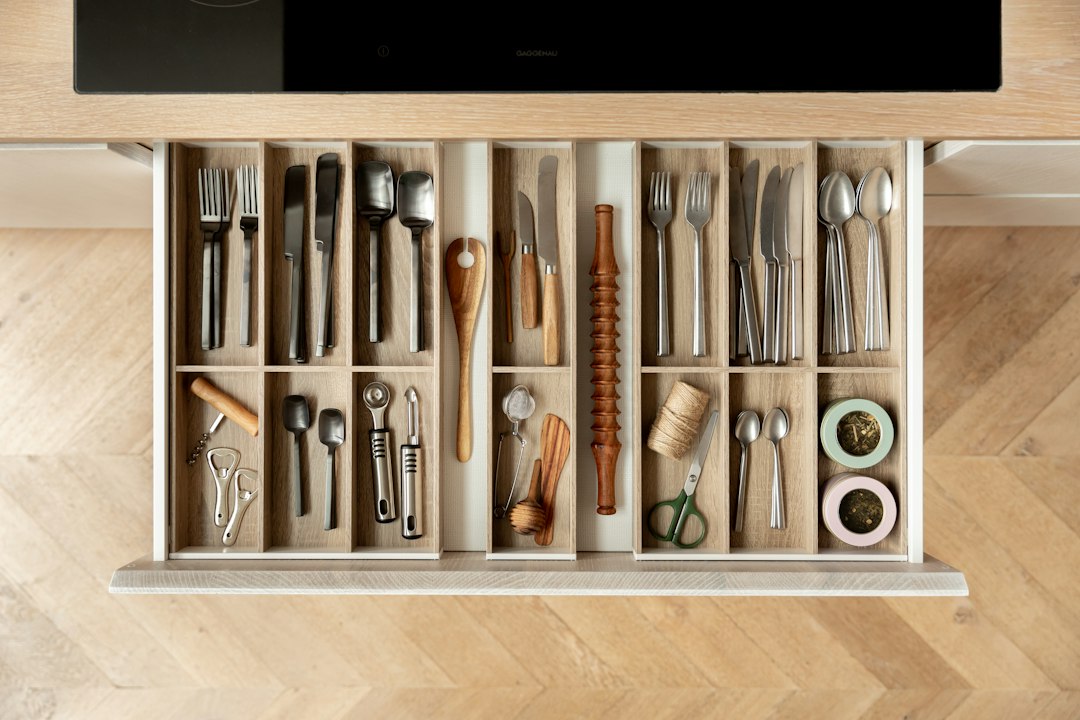
Dividers create sections without using much vertical space.

They work well for:
- utensils;
- clothing;
- office supplies;
- bathroom items;
- long or awkward objects.
Adjustable dividers can be useful when category sizes change.
Drawer dividers: limits
Dividers may not contain very small objects well.
They can also shift if they do not fit the drawer securely.
Check:
- drawer width;
- interior height;
- divider expansion range;
- contact points or non-slip features.
Small bins: strengths
Bins create stronger boundaries.
They work well for:
- clips;
- batteries stored appropriately;
- small grooming items;
- craft supplies;
- cord adapters;
- small hardware.
A removable bin can also make cleanup easier because the whole category can be lifted out.
Small bins: limits
Bins take up their own footprint and can leave unusable gaps.
They may also be too deep for shallow drawers or too narrow for larger items.
Matching sets can look organized while actually reducing usable space.
Side-by-side decision factors
Flexibility
Dividers: often better for changing section sizes.
Bins: better for fixed small categories.
Visibility
Dividers: everything stays on the same plane.
Bins: contents are contained but may disappear in deep containers.
Cleaning
Dividers: fewer pieces to remove.
Bins: easy to lift out individually.
Small items
Dividers: may allow migration under gaps.
Bins: stronger containment.
Large or long items
Dividers: often more efficient.
Bins: can waste space around the object.
A hybrid can work best
You can use one divider to create broad zones and one or two small bins inside a zone for tiny items.
Do not combine so many products that the drawer becomes harder to use.
Measure before buying
Measure:
- interior width;
- depth;
- height;
- drawer hardware that reduces usable space.
Also measure the largest item that needs to fit.
Common mistakes
- buying organizers before removing clutter;
- choosing bins deeper than the drawer;
- using small bins for large categories;
- filling every inch with containers;
- buying a matching set instead of solving the actual problem.
Which works better for a junk drawer?
Usually a mix. Use dividers for pens, tape and tools, and small bins for tiny objects.
See How to Organize a Junk Drawer So It Stays Useful for the full system.
What to buy
Once the drawer and categories are measured, compare exact-fit dividers or bins through Happi Resources or our approved Amazon route. If a verified GearReady product exactly fits the use case, GearReady remains the preferred first-party route. This is research-based guidance, not hands-on testing of every organizer.
What to do next
Empty one drawer, define its categories and measure the interior before choosing a divider or bin.